Sunday, August 16
Eugene, OR
1:00 PM

University of Oregon
vs

Gonzaga
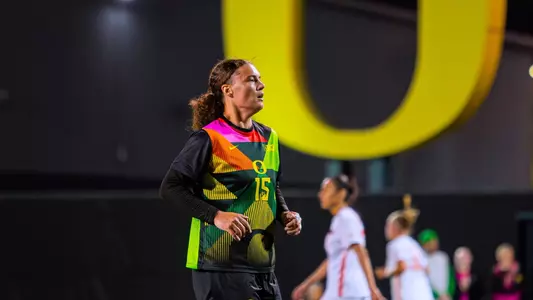
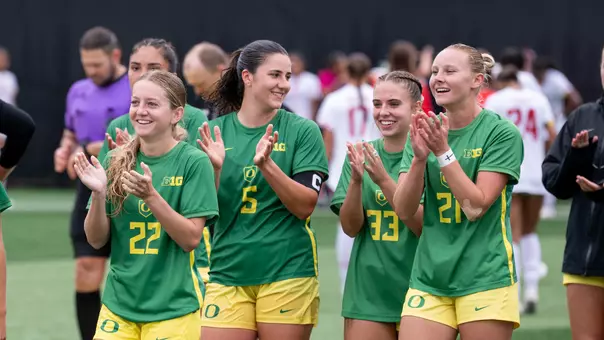
Photo by: GoDucks.com
Soccer's Bloom Authors Book on Injury Awareness
08/15/26 | Women's Soccer
Oregon senior Cailin Bloom's graduate degree program led her to write a book on the mental hurdles of recovering from knee surgery.
EUGENE, Ore. — At some point after first touch Sunday afternoon at Papé Field, fans might be able to look across the pitch toward Oregon defender Elise Picard and see, if their eyes are sharp and the sun provides enough of a glint, the junior defender's eyes welling up with tears.
The Ducks host Gonzaga on Sunday at 1 p.m., fresh off a 3-0 win Thursday over Portland State. Sunday's match isn't just the UO women's home opener, it's also the chance for Picard to make her competitive return to Papé Field after a season lost to a knee injury — a common theme in the careers of about a quarter of Oregon's roster, and a prevalent enough issue to have inspired one Oregon student-athlete to write a book about it.
Picard missed most of last season with her second career ACL injury, which eight current UO players have had to overcome at some point in their careers. Among them is sixth-year forward Cailin Bloom, who was compelled to write a book about the mental and physical toll the injury can take.
The lows of the rehabilitation process can be very low, she found. But the thrill of coming out the other side as a fuller and stronger person can't be denied, too. Which is why Picard figures she'll be so emotional Sunday.
"I will literally, like, tear up every time I see someone do something for the first time post-ACL," said Picard, who played 54 minutes off the bench in Thursday's victory over the Viks. "Because I've been there; we know what it's like. Every single one of us that have taken the field after an ACL, it's so emotional and it's just such a proud moment. The respect is insane, because we all know how hard it is."

Bloom decided to document the experience she and other student-athletes have had recovering from injury in a book she wrote and is currently looking to get published, "Torn But Not Broken." The genesis of the book was a class she took as part of her master's program in the UO School of Journalism's Advertising and Brand Responsibility field.
A transfer from Cal, Bloom had to overcome an ACL injury and subsequent complications during her recovery as a college freshman and sophomore. Now a graduate student, Bloom has a fresh perspective on the experience, one she shares in the book, along with stories of other athletes' experiences.
"Looking back years later, I'm like, yeah, it shaped me into who I am," said Bloom, who transferred to Oregon for the 2025 season and scored the first two goals of her career last fall.
The daughter of an Olympic shot putter and a college softball player, Bloom was the defensive player of the year in her high school league before enrolling at California. But her college experience was quickly derailed by a spring ACL tear her freshman year, followed by meniscus issues that sidelined her even longer.
UO coach Tracy Joyner, who knows first-hand the experience of dealing with an ACL tear, preaches resilience to her team. And she has watched Bloom embody it.
"The first three or four years of her career definitely didn't go the way that anyone wanted," Joyner said. "And to continue to fight for it and be passionate about something and not give up, I think a lot of people would have probably just thrown in the towel at that point. But she kept fighting."

Picard rode the same roller coaster over the last year, and has a different appreciation for the weight of the words, "torn ACL."
"You're out for so long," said Picard, who met Bloom two years ago when Picard was at Oregon recovering from her first career ACL injury, and Bloom was visiting Eugene as a potential transfer. "You see someone in a brace, and then you kind of forget about it. And then some time later you're like, oh, you're playing again — that's great. That's kind of all you see unless you know someone that's close to you that did it, or you do it yourself. You don't understand how hard it is, the mental toughness, the physical toughness it takes."
Among the biggest early challenges is being robbed of athleticism and team participation that become defining to young people and their sense of self. And then there's the physical pain — Picard said she wasn't able to stand up in the shower for a period of time, and Bloom recalls not wanting to drink fluids, to avoid agonizing trips to the bathroom.
Sports, by their nature, can be humbling. But those challenges truly take courage to face.
"When I went through mine, I knew how hard it was, but to other people looking in, a lot of people thought I was fine," Picard said. "Because that's what you want to do — you want to put a face on for people and not show that you're weak. But people really do need to understand that it is a lot."
In trying to spread awareness about the challenges of recovering from an ACL injury, Bloom has posted interview clips on social media with some of the athletes she spoke to for the book. Clearly, the message has an audience in the greater athletics universe.
"I've had younger athletes DM me, and they're just like, 'I love what you're doing,'" Bloom said. "I've had some that are just like, 'Can I please share my story?' And I'm like, yes, absolutely."

What some of those athletes have learned through experience, and what Bloom hopes to communicate to anyone newly diagnosed with an ACL tear, is that there's life on the other side of injury.
"You're gonna be upset; you're gonna be frustrated," Bloom said. "But everybody I've talked to and everybody I've interviewed, they have all said, it's one of the best things that's ever happened to me. It's something that taught me so much about myself."
Some gain a new appreciation for their sport. Some gain the realization that there's more to life than just sport. For many, it's a mix of both. And for all, there's a new appreciation for the hurdles they're able to overcome.
"From where she was a year ago, I wouldn't say she's unrecognizable, but she is significantly different in terms of her demeanor, her personality, her contributions on and off the field," Joyner said of Bloom, who played 40 minutes and registered two shots in Thursday's win. "It's not a maturity piece; it was more like just this growth where she kind of just decided, I'm not gonna let this take over who I am and my career and what I've been about. I'm gonna do something positive with it. And it's like, the world's not out to get her anymore."
More than half a dozen of Bloom's teammates have experienced similar growth back from an ACL injury. The lessons they've learned now permeate Oregon's roster.
"If players are not putting in the effort we're expecting of them, you've got players on the side that can't play at all, and it's so upsetting for them," Joyner said. "They're like, I wish I could be out there. I would be dying on the field to get to that ball, and you're walking. You've got eight voices out there that are like, you better do what's being asked of you, because when you don't have it, yeah, you certainly wish you could do it."
In some ways, that kind of perspective can be tough to digest without experiencing it first-hand. But Bloom hopes her story, and her book featuring the stories of other athletes, can help impart it.
"With her writing a book and also her performance on the field, it's pretty significant, and I think that certainly should be an inspiration to other players," Joyner said. "It's not over. And the power of belief, and the power of believing in someone, it just can be really impactful."
The Ducks host Gonzaga on Sunday at 1 p.m., fresh off a 3-0 win Thursday over Portland State. Sunday's match isn't just the UO women's home opener, it's also the chance for Picard to make her competitive return to Papé Field after a season lost to a knee injury — a common theme in the careers of about a quarter of Oregon's roster, and a prevalent enough issue to have inspired one Oregon student-athlete to write a book about it.
Picard missed most of last season with her second career ACL injury, which eight current UO players have had to overcome at some point in their careers. Among them is sixth-year forward Cailin Bloom, who was compelled to write a book about the mental and physical toll the injury can take.
The lows of the rehabilitation process can be very low, she found. But the thrill of coming out the other side as a fuller and stronger person can't be denied, too. Which is why Picard figures she'll be so emotional Sunday.
"I will literally, like, tear up every time I see someone do something for the first time post-ACL," said Picard, who played 54 minutes off the bench in Thursday's victory over the Viks. "Because I've been there; we know what it's like. Every single one of us that have taken the field after an ACL, it's so emotional and it's just such a proud moment. The respect is insane, because we all know how hard it is."
Bloom decided to document the experience she and other student-athletes have had recovering from injury in a book she wrote and is currently looking to get published, "Torn But Not Broken." The genesis of the book was a class she took as part of her master's program in the UO School of Journalism's Advertising and Brand Responsibility field.
A transfer from Cal, Bloom had to overcome an ACL injury and subsequent complications during her recovery as a college freshman and sophomore. Now a graduate student, Bloom has a fresh perspective on the experience, one she shares in the book, along with stories of other athletes' experiences.
"Looking back years later, I'm like, yeah, it shaped me into who I am," said Bloom, who transferred to Oregon for the 2025 season and scored the first two goals of her career last fall.
The daughter of an Olympic shot putter and a college softball player, Bloom was the defensive player of the year in her high school league before enrolling at California. But her college experience was quickly derailed by a spring ACL tear her freshman year, followed by meniscus issues that sidelined her even longer.
UO coach Tracy Joyner, who knows first-hand the experience of dealing with an ACL tear, preaches resilience to her team. And she has watched Bloom embody it.
"The first three or four years of her career definitely didn't go the way that anyone wanted," Joyner said. "And to continue to fight for it and be passionate about something and not give up, I think a lot of people would have probably just thrown in the towel at that point. But she kept fighting."
Picard rode the same roller coaster over the last year, and has a different appreciation for the weight of the words, "torn ACL."
"You're out for so long," said Picard, who met Bloom two years ago when Picard was at Oregon recovering from her first career ACL injury, and Bloom was visiting Eugene as a potential transfer. "You see someone in a brace, and then you kind of forget about it. And then some time later you're like, oh, you're playing again — that's great. That's kind of all you see unless you know someone that's close to you that did it, or you do it yourself. You don't understand how hard it is, the mental toughness, the physical toughness it takes."
Among the biggest early challenges is being robbed of athleticism and team participation that become defining to young people and their sense of self. And then there's the physical pain — Picard said she wasn't able to stand up in the shower for a period of time, and Bloom recalls not wanting to drink fluids, to avoid agonizing trips to the bathroom.
Sports, by their nature, can be humbling. But those challenges truly take courage to face.
"When I went through mine, I knew how hard it was, but to other people looking in, a lot of people thought I was fine," Picard said. "Because that's what you want to do — you want to put a face on for people and not show that you're weak. But people really do need to understand that it is a lot."
In trying to spread awareness about the challenges of recovering from an ACL injury, Bloom has posted interview clips on social media with some of the athletes she spoke to for the book. Clearly, the message has an audience in the greater athletics universe.
"I've had younger athletes DM me, and they're just like, 'I love what you're doing,'" Bloom said. "I've had some that are just like, 'Can I please share my story?' And I'm like, yes, absolutely."
What some of those athletes have learned through experience, and what Bloom hopes to communicate to anyone newly diagnosed with an ACL tear, is that there's life on the other side of injury.
"You're gonna be upset; you're gonna be frustrated," Bloom said. "But everybody I've talked to and everybody I've interviewed, they have all said, it's one of the best things that's ever happened to me. It's something that taught me so much about myself."
Some gain a new appreciation for their sport. Some gain the realization that there's more to life than just sport. For many, it's a mix of both. And for all, there's a new appreciation for the hurdles they're able to overcome.
"From where she was a year ago, I wouldn't say she's unrecognizable, but she is significantly different in terms of her demeanor, her personality, her contributions on and off the field," Joyner said of Bloom, who played 40 minutes and registered two shots in Thursday's win. "It's not a maturity piece; it was more like just this growth where she kind of just decided, I'm not gonna let this take over who I am and my career and what I've been about. I'm gonna do something positive with it. And it's like, the world's not out to get her anymore."
More than half a dozen of Bloom's teammates have experienced similar growth back from an ACL injury. The lessons they've learned now permeate Oregon's roster.
"If players are not putting in the effort we're expecting of them, you've got players on the side that can't play at all, and it's so upsetting for them," Joyner said. "They're like, I wish I could be out there. I would be dying on the field to get to that ball, and you're walking. You've got eight voices out there that are like, you better do what's being asked of you, because when you don't have it, yeah, you certainly wish you could do it."
In some ways, that kind of perspective can be tough to digest without experiencing it first-hand. But Bloom hopes her story, and her book featuring the stories of other athletes, can help impart it.
"With her writing a book and also her performance on the field, it's pretty significant, and I think that certainly should be an inspiration to other players," Joyner said. "It's not over. And the power of belief, and the power of believing in someone, it just can be really impactful."

Players Mentioned

F
/ Women's Soccer
D
/ Women's SoccerMonday, October 12
Monday, October 12
Monday, October 12
Friday, October 09